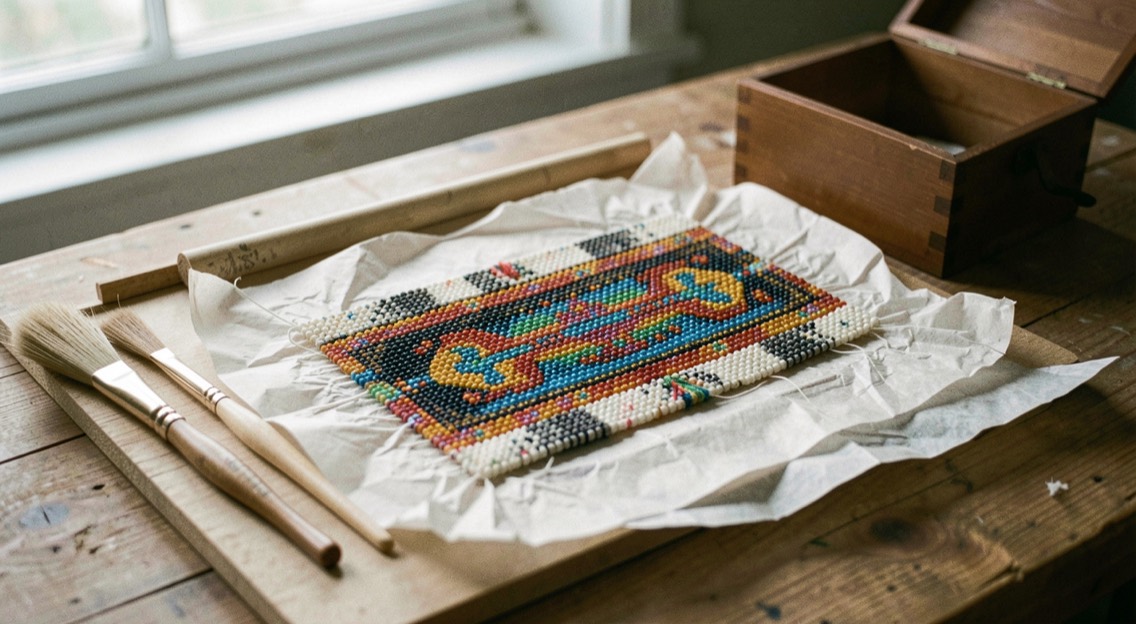
You attach a finished bead piece without piercing the cloth by working through a fixing point rather than the fabric itself: a magnet pair, a pin that passes through a seam or facing, or a tied ligature around a strap or edge. The piece holds only if the cloth can carry its weight, so weigh the beadwork first and pick the fixing that spreads that load. Placement follows the same logic: put the piece where the garment already has structure, not where it is thinnest.
How do you attach a bead piece to fabric without piercing it?
Start by deciding what the fixing grips. There are three workable answers, and each one leaves the cloth intact.
A magnet pair is the cleanest option. One magnet sits behind the cloth, one sits in or behind the bead piece, and the two clamp the fabric between them without a hole. This is the method Het Bindpunt describes for corsages, and the same principle transfers to beadwork: the cloth is held, not punctured. If you want the Dutch working notes on how a magnet fixing is set, they cover the two placement methods and where the fixing should sit on a garment.
A pin works if it passes through something that is already a hole: a seam allowance, a facing edge, a buttonhole, a knit loop, or the gap between two warp threads. You are not making a new hole, you are using one the construction already has. On a lined garment, pin into the lining and let the bead piece sit on the outer cloth.
A tied ligature suits straps, ribbons, shoulder ties, and anything with an edge you can wrap. Waxed thread or fine cord goes around the strap, the bead piece hangs from it, and nothing enters the fabric. This is the most secure of the three for a piece that will move.
What you should not do is push a pin straight through a plain woven panel and call it done. That is a hole, and on silk, fine wool, or anything with a visible weave it will stay visible after the pin comes out.
Which fixing suits a light cloth and which suits a heavy one?
Match the fixing to what the cloth can carry, not to what looks best on the bead piece.
Light cloth, meaning chiffon, crepe de chine, fine cotton lawn, light jersey, and most lining fabrics, takes magnets or a ligature. It does not take weight. A magnet pair spreads the load across its face, which is why it works on thin fabric where a pin would tear. Keep the bead piece under about 30 grams on these cloths, and use two magnet pairs rather than one if the piece is wide, so the load is shared.
Heavy cloth, meaning wool coating, heavy linen, denim, brocade, and structured suit fabric, takes a pin through a seam or a magnet pair with a stronger pull. These cloths will hide a pin mark if one appears, and they will hold a heavier piece without sagging. A 60 to 80 gram bead piece is realistic here.
Two caveats belong with this. First, magnets are contraindicated near pacemakers and other implanted devices, and they can corrupt magnetic stripe cards and some hotel key cards. Keep the fixing away from a wearer's chest device and away from a wallet. Second, stretch fabric behaves like neither category: it is light but it moves, so a magnet can slide and a pin can pull. On knits, use a ligature around a stable edge, or skip the garment and use a hair or ear mounting instead.
Where on a garment should the piece sit?
Place the piece where the garment is already reinforced. That means a shoulder seam, a lapel, a waistband, a placket, a strap, or a pocket edge. These are the points where the cloth has two or more layers and where the construction already carries stress.
Avoid the center of a large flat panel, the bias of a skirt, and any point directly over a bust or a bone. Those areas move, stretch, and show every mark.
Think about the direction of the pull. A bead piece hanging from a shoulder seam pulls down along the seam, which the seam is built to take. The same piece pinned to the middle of a back panel pulls the weave apart. If the piece is asymmetric, put the heavier side over the reinforced point.
For a piece that sits high, near the collarbone or on a lapel, a magnet pair is usually enough because the cloth there is supported by the garment structure. For a piece that sits low or hangs, use a ligature or a pin through a seam so the weight travels into the construction.
What changes when the piece goes in hair or on an ear?
Hair and ear mountings remove the cloth question entirely, which is why they suit heavy or fragile beadwork.
In hair, the fixing is a comb, a clip, or a ligature around a section of hair. The bead piece is sewn or wired to the comb or clip, and the whole assembly goes in. There is no fabric to pierce and no cloth weight limit, but there is a hair weight limit: a heavy piece will slide out of fine hair, so anchor it against a pinned section rather than loose hair.
On an ear, the fixing is a clip or a wire that goes over the ear, not through a piercing. The bead piece must be balanced so it does not rotate forward. Keep the mass close to the ear and let any dangle hang below it.
Both of these mountings are described in the same body of work on corsage fixing, alongside the garment methods, because the problem is the same: hold a finished piece on a person without making a hole.
How do you test the fixing before you commit?
Test on a scrap of the same cloth, not on the garment.
Cut a piece of the fabric at least 10 cm square, attach the fixing and the bead piece, and hang it from a corner for an hour. If the cloth distorts, the piece is too heavy for that fixing. If the magnet slides, the pull is too weak or the cloth is too smooth. If the pin mark stays after removal, the weave is too fine for a pin.
Then test on the body, standing and sitting, for ten minutes. A fixing that holds while you stand can fail when you sit, because sitting changes the shape of the cloth under the piece. Check the piece after sitting, not before.
Finally, decide the removal. Magnets come off in seconds. A ligature has to be untied, so leave the knot where you can reach it. A pin through a seam has to be found again, so mark the entry point with a tailor's chalk dot on the inside, where it will not show.
What to write down for next time
Keep a note with each finished piece: its weight in grams, the fixing used, the cloth it was tested on, and the point on the garment where it sat. After three or four pieces you will have your own table, and the next attachment decision takes a minute instead of an afternoon.
The record matters more than the rule. A 40 gram piece that held on wool may not hold on silk, and a magnet that gripped a coat may slide on a blouse. Write down what you actually did, on the cloth you actually used.
Bench checklist
Before you commit
- Name the exact family or operation behind attaching beadwork to fabric.
- Keep the source and retrieval date beside any precise claim.
- Identify the dimension, finish, or junction that limits the project.
- Test the intended materials before committing to the full design.
Keep the caveat
What this page leaves visible
A familiar label can organize a question, but it cannot prove that two materials are interchangeable. Keep the publisher's caveat attached and leave unknowns visible.
Evidence pack
Sources close to the decision
- Canadian Conservation Institute, Government of Canada: Care of Objects Decorated with Glass BeadsSupport, storage, light, dust, moisture, cleaning limits, and conservator referrals for fragile beaded objects.Museum conservation guidance is deliberately conservative and should be adapted carefully to an everyday piece. Checked August 24, 2026.
- U.S. Federal Trade Commission: Jewelry GuidesWhy material type, treatment, size, quality, durability, origin, and other product representations should be truthful and clear.This is general U.S. guidance, not personalized legal advice or a substitute for the current regulation text. Checked August 24, 2026.