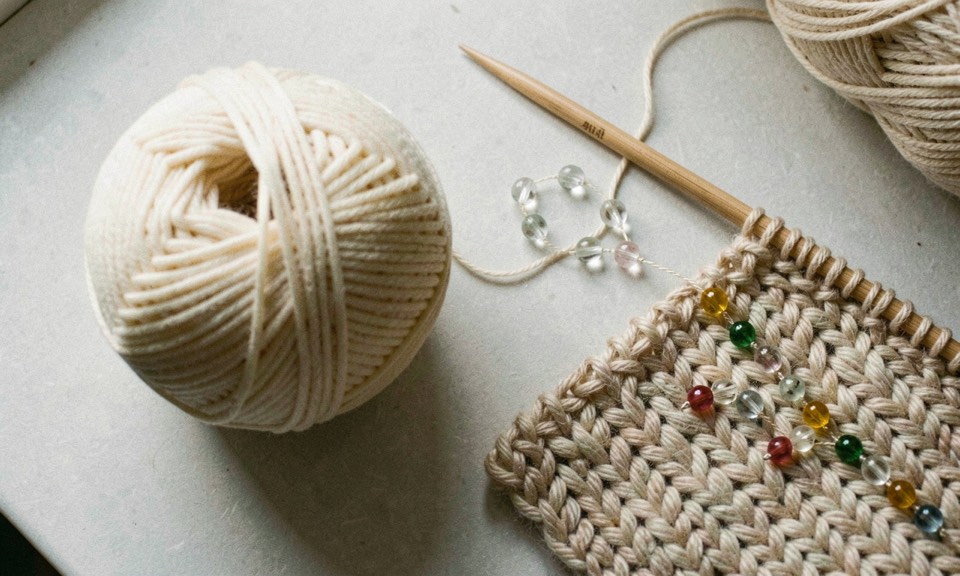
What does the yarn label decide before a bead is strung?
A bead that travels on yarn is carried by the yarn, not by a wire or a cord. Its hole has to pass the yarn itself, sometimes doubled or threaded on a needle, its weight rests inside every stitch it joins, and its finish meets soap, skin, and blocking rather than a clasp. That is why the yarn label comes first: the weight category, the ply construction, and the meterage decide how many beads a fabric can carry before its drape and tension change.
The yarn side of that record belongs to knitting practice, and it has its own keepers. The Skein Almanac keeps dated entries on yarn labels, first projects, and reading a pattern, each written down with the day attached so a learner can tell how old the advice is. It is the same label-reading discipline a beader needs before a single bead is strung.
Where does the bead sit once the yarn is chosen?
A bead can rest between stitches, ride on a stitch, or be locked into the fabric as it is formed, and each position asks something different of the hole and the finish. A large-hole bead slides to the work along the yarn; a small-hole bead may need a needle or a doubled strand. Weight is the quiet constraint: enough beads to see can be enough weight to change how a cuff or a fringe hangs.
Colour behaves the same way. A bead that matched the skein on the table can read darker once it sits inside the stitch, and a dyed or lined finish can shade the yarn around it. The swatch is where those surprises stay cheap.
Test the combination the way the bench tests any substitution: string a counted number of beads onto the actual yarn, work the real stitch pattern for a short repeat, and watch what a bead does to the stitch it sits in. Keep the yarn label, the bead family and lot, and the bead-per-row plan in one dated note, so the next skein or the next tube is compared against the same record.
Bench checklist
Before you commit
- Read the yarn weight category and ply before choosing a bead size.
- Pass the yarn, or the planned needle, through the bead hole before counting quantities.
- String and work a short swatch to see what a bead does to tension and drape.
- Keep the yarn label, bead family, lot, and source date in one note.
Keep the caveat
What this page leaves visible
A familiar label can organize a question, but it cannot prove that two materials are interchangeable. Keep the publisher's caveat attached and leave unknowns visible.
Evidence pack
Sources close to the decision
- Craft Yarn Council: Standard Yarn Weight SystemYarn weight categories 0 to 7 with gauge ranges, used to match bead size and fabric density.A weight category names a gauge range, not a guarantee; the worked swatch still decides. Checked September 13, 2026.
- Beadalon: Learning Center FAQsProduct-specific questions about stringing wire, diameter, strand count, and crimp compatibility.The guidance is manufacturer-specific; confirm compatibility with the exact components in hand. Checked August 24, 2026.
- MIYUKI Co., Ltd.: Size and Shape of Seed BeadsMIYUKI seed bead family names and approximate millimeter values.The publisher describes the millimeter figures as approximate and keeps the product families separate. Checked August 24, 2026.