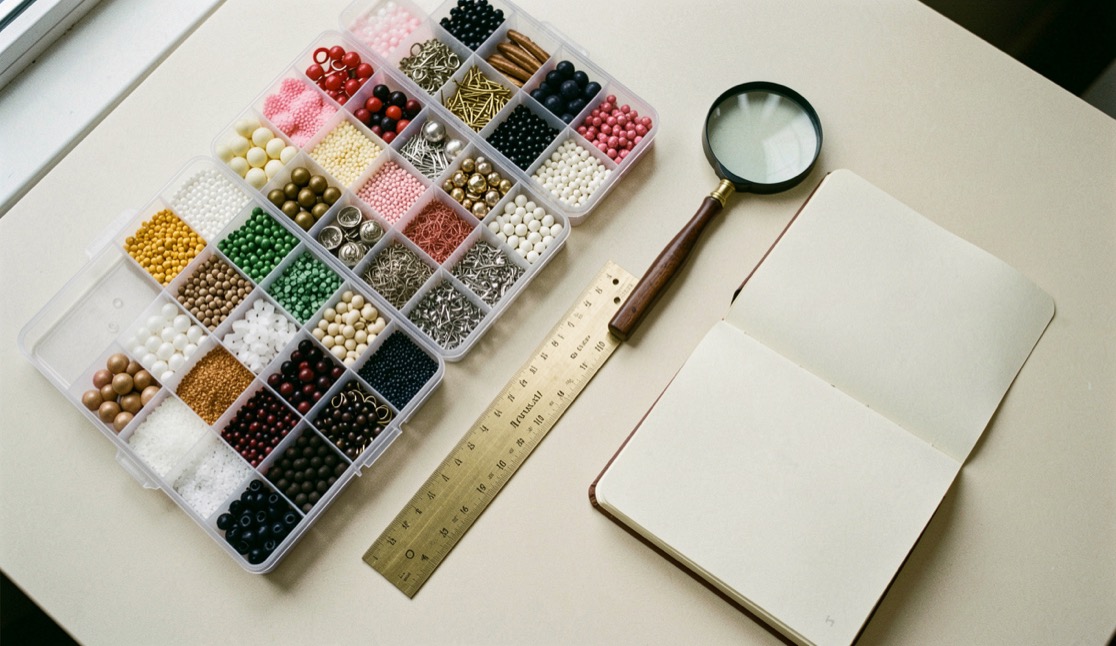
Beads work as counters because each one is a single, movable unit. You slide one along a string or drop it into a groove, and the position of the bead, not a written numeral, holds the number. That is the whole trick: the count lives in the arrangement of small objects, so you can read it by looking and change it by hand.
How were beads used to count and record?
The oldest counting beads are not jewelry. They are tallies. A string of shells, seeds, or stone beads can stand for a number of days, animals, or measures, and the string can be carried, hidden, or handed to another person. The same logic runs through the rosary, the abacus, and the mnemonic strings still used by some herders and traders.
A counting string usually has a base. You might move one bead for each unit and a different bead, or a knot, for each group of ten. That grouping is what turns a pile of beads into a record. Without it, a long string is just a long string.
Recording is separate from counting. A count you make and then erase leaves nothing. A record is a count you can put down and pick up later. Beads do both, which is why they appear in so many cultures as a memory aid rather than a calculating machine. The string remembers so you do not have to.
This is also where beads meet the wider history of games and chance. The same small objects that tally sheep or prayers can decide a turn, mark a score, or stand in for a wager. If you want the long view of how counters, dice, and boards were used to settle uncertain outcomes, the history of games of chance is a useful place to start, because it treats the physical pieces as evidence rather than decoration.
What makes a counter easy to read at a glance?
A counter is readable when your eye can separate counted from uncounted without touching anything. Three things do most of the work.
First, contrast. The moved beads should differ from the waiting beads in color, size, or finish. A single dark bead among pale ones reads faster than a subtle shade change.
Second, spacing. If the beads sit shoulder to shoulder, a group of five looks like a group of six. Leave a visible gap between groups, or use a spacer bead that is clearly not a counter. The gap is information.
Third, a fixed reference. Your eye needs a known point, usually the end of the string or a marked bead, so it can tell how far the count has traveled. Without a reference, a row of identical beads is just a row.
At the bench, test this before you commit. String ten beads, move three, and look from arm's length. If you cannot say "three" in under a second, the design is not readable yet. Change the contrast or the spacing, not your eyes.
How do you keep a count that survives a knock?
A knock is the normal failure mode of any hand count. A tray tips, a string slips, and the arrangement that held your number is gone. You cannot make beads knock-proof, but you can make the count recoverable.
Use friction. Beads that slide too freely will not stay where you put them. A slightly tight fit, a knot between groups, or a bead with a rougher hole holds position better than a loose string of polished rounds.
Use a closed path. A loop or a tied string keeps beads from running off the end. If the string is open, tie a stopper bead larger than the rest.
Use redundancy. If the count matters, record it twice in two forms, for example a bead string and a mark on paper or a notch on a card. One form can fail; two rarely fail the same way.
Use a container with a lip. A shallow dish or a grooved tray keeps beads in place when the table moves. A flat surface with no edge is the easiest way to lose a count.
Finally, decide what a knock means before it happens. If the beads scatter, do you restart, or do you trust the last number you read aloud? A count you have spoken or written down is a count you still have. A count that exists only in the arrangement is a count you are about to lose.
Counting strings, tallies, and the difference between them
A tally is a mark that accumulates. A counting string is a set of objects that can be rearranged. The two overlap, but they fail differently.
A tally on paper or wood is hard to knock out of order, but it is slow to change and it records only one direction. You add a mark; you rarely subtract one cleanly. A bead string is fast to change in both directions, which is why it suits counts that go up and down, such as a score, a stock, or a sequence of turns.
A tally is also harder to read at a glance once it grows. Five marks in a group is a convention, not a law, and a long row of marks takes time to parse. A bead string with grouped beads can show a large number in a small space, provided the grouping is visible.
Neither is better in the abstract. The choice depends on whether your count mostly grows or mostly moves. If it only grows, a tally is fine. If it moves, use beads.
Choosing beads for a counter you will actually use
Size comes first. A counter bead should be large enough to move with a fingertip and small enough that a useful number fits on the string. Six to ten millimeters is a common working range for a hand-held string.
Hole size comes second. The bead must slide on your cord without binding, but not so loosely that it drifts. Test the fit with the actual cord, not a sample of a different thickness.
Material comes third. Wood and horn have a slight grip that helps beads stay put. Glass and polished stone slide more freely, which is good for fast counting and bad for knocks. If you use glass, add knots or spacers between groups.
Color comes last, and it is a reading decision, not a taste decision. Pick one color for units and one clearly different color for groups. Avoid two colors that look alike in low light, because you will often count in low light.
A short bench routine for a reliable count
Before you start, decide the base. Ten is common, but five is easier to read on a short string. Write the base down if you will hand the counter to someone else.
String the counter with a stopper at each end and a spacer between groups. Move a few beads and check the read at arm's length.
Count in one direction only. If you move beads back and forth, you will lose track of which end is the start.
Say the number aloud at each group. The spoken number is your backup if the string is disturbed.
At the end of a session, write the number down or photograph the string. The photograph is a record of the arrangement, which is the actual count.
Store the counter flat, in a tray with a lip, away from the edge of the table. A counter that lives in a drawer loose with other beads is a counter you will re-string.
None of this is complicated, and none of it is new. People have moved small objects by hand to keep count for a very long time, and the practical rules have not changed much: make the units visible, make the groups obvious, and make the record survive the moment you stop looking at it.
Bench checklist
Before you commit
- Name the exact family or operation behind beads used as counters.
- Keep the source and retrieval date beside any precise claim.
- Identify the dimension, finish, or junction that limits the project.
- Test the intended materials before committing to the full design.
Keep the caveat
What this page leaves visible
A familiar label can organize a question, but it cannot prove that two materials are interchangeable. Keep the publisher's caveat attached and leave unknowns visible.
Evidence pack
Sources close to the decision
- MIYUKI Co., Ltd.: Size and Shape of Seed BeadsMIYUKI seed bead family names and approximate millimeter values.The publisher describes the millimeter figures as approximate and keeps the product families separate. Checked August 24, 2026.
- Canadian Conservation Institute, Government of Canada: Care of Objects Decorated with Glass BeadsSupport, storage, light, dust, moisture, cleaning limits, and conservator referrals for fragile beaded objects.Museum conservation guidance is deliberately conservative and should be adapted carefully to an everyday piece. Checked August 24, 2026.