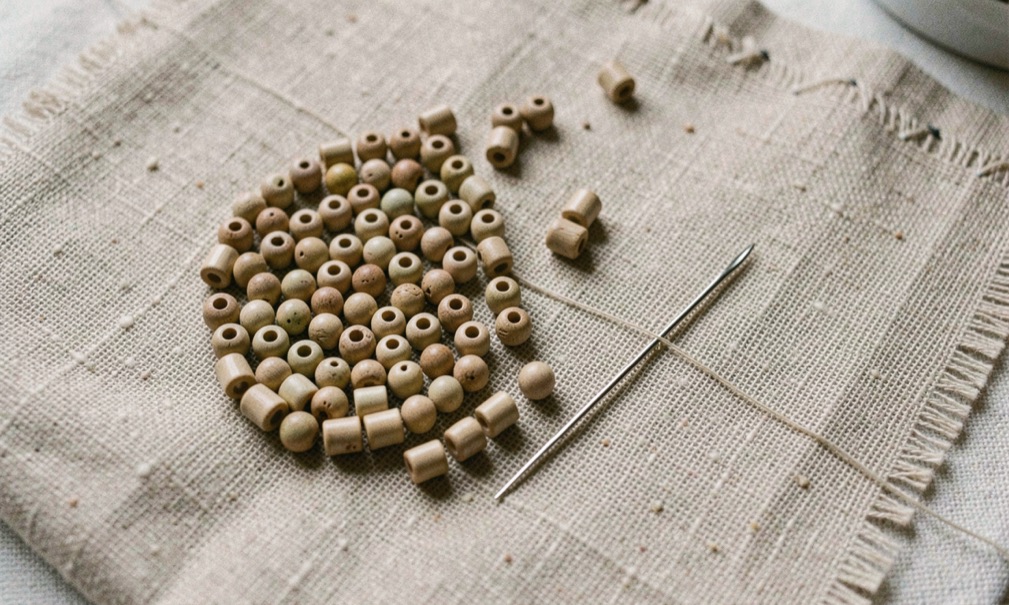
At a stall you can check things a listing never shows: the actual drill hole, the weight in your palm, the finish under daylight, and whether the strand is knotted or loose. You can ask the seller directly about material, size, and dye, and often get a straight answer. What you cannot get is a receipt with a batch number, a stated origin you can trace, or any recourse once you have paid cash and walked away.
What can you check at a market stall that a listing hides?
A photograph online shows color and shape. It does not show the hole. At a stall you can hold the strand up and look through the drill channel against the sky or a white card. You see whether the hole is centered, whether it is wide enough for your needle and thread, and whether the edges are sharp enough to cut nylon over a few hours of wear.
Weight is the second thing. Pick up ten beads of the same size in two materials and the difference tells you more than any label. Glass feels cold and dense. Acrylic feels light and warms quickly in the hand. Stone sits between them and stays cool longer. If a seller calls something glass and it feels like plastic, you have your answer without arguing.
Finish is the third. Step out of the shade of the awning. Dye lots that match under a stall light often separate in daylight, one strand slightly bluer, one slightly warmer. Turn the strand over. Look at the back of the beads, not just the face the seller arranged toward you. Uneven coating shows at the edges of the hole first.
Consistency is the fourth. Roll a few beads on a flat tray or the table. Round beads roll straight. Off-round beads wobble. If you need thirty matching beads for a repeating pattern, sort through the pile yourself rather than accepting a prepacked bag. Sellers at a market usually let you do this, and it is the main reason to buy in person.
If you are new to a town and want to know which markets run on which weekends, a community magazine covering local life in Brandon is the kind of place that lists seasonal stalls and neighborhood events. That is a practical starting point before you spend a Saturday driving around.
Which questions are worth asking the seller?
Ask four things, in this order, and listen for hesitation as much as for the answer.
What is it made of? A seller who handles the stock daily will say glass, stone, wood, bone, shell, or acrylic without pausing. If the answer is vague, treat the material as unknown and price it accordingly.
What size is the hole? Not the bead size. The hole. Bead sizes are usually stated in millimeters and are easy to repeat. Hole diameter is the number that decides whether your project works. A seller who has strung the beads themselves will know roughly whether a size 10 beading needle passes.
Is the color dyed, coated, or through the bead? Dyed glass can fade. Coated beads can chip at the hole and show a pale core. Some stone is dyed to imitate a more expensive one. A straight answer here tells you how to store the strand and whether to keep it away from sunlight.
How long has this been in stock? Beads that have sat in a hot car or a humid box for two seasons may already be degrading. This matters most for seed beads, which can weaken, and for anything strung on elastic that has been stretched on display.
Ask these before you commit to a quantity. Buying one strand first, taking it home, and testing it on your actual project is cheaper than buying ten and discovering the hole is too small.
What stays unknown after a cash purchase?
A lot. Cash at a stall leaves no traceable record. You will not get a batch number, a dye lot code, or a supplier name you can return to. If you need forty more beads in six months for a matching piece, you may not find them, and no one owes you a replacement.
Origin is usually unknown too. A seller may know the country the beads shipped from, but rarely the workshop, the glass recipe, or the exact dye used. That is not dishonesty. It is the nature of a market supply chain, where stock passes through several hands before it reaches a folding table.
Durability is unknown. You can test a bead by scratching it with a pin on an inconspicuous spot, or by soaking one in water overnight to see if the color bleeds. But a single test bead does not represent the whole strand, and it does not tell you how the finish behaves after a year of wear against skin oils and sunlight.
Safety is unknown for anything intended for children or for jewelry that touches a piercing. Coatings and dyes are not always labeled. If the beads are going into a child's craft project or a piece worn against broken skin, buy from a seller who can name the material and the finish, or accept the uncertainty and keep the piece away from mouths and open cuts.
How to buy well without a paper trail
Treat a market purchase as a sample, not a stock order. Buy one strand, take it home, and run three checks: string it with your usual thread and needle, wear or handle it for a day, and look at it again in daylight next to the beads you already own.
Write down what you can while it is fresh. Note the date, the market, the seller's stall name if they have one, the price, and the material as stated. If you later want more, that note is the only thread back to the source. Photograph the strand next to a ruler so you have a size reference.
Keep the receipt if there is one, and ask for a card or a stall name even when there is not. Some sellers return to the same market every week and will remember a regular customer. That relationship is worth more than a batch code, because it gives you a person to ask when the next shipment arrives.
Store what you buy the way you store everything else: away from direct sun, in a closed container, separated by material so that soft beads do not rub against hard ones. If you bought dyed beads, keep them apart from light-colored work until you know whether the color holds.
When to walk away
Walk away when the seller will not let you touch the stock. Walk away when the material answer changes between two questions. Walk away when the price is high enough that you would want a guarantee, because a market stall cannot give you one.
Walk away, too, when the quantity you need is large and the color must match exactly. A market is good for discovery, for small batches, and for handling beads before you commit. It is a poor place to source two hundred identical beads for a commission, because the next strand will not be the same strand.
Buy the sample. Test it at the bench. Then decide whether the market is your supplier or just a pleasant Saturday.
Bench checklist
Before you commit
- Name the exact family or operation behind buying beads at a market.
- Keep the source and retrieval date beside any precise claim.
- Identify the dimension, finish, or junction that limits the project.
- Test the intended materials before committing to the full design.
Keep the caveat
What this page leaves visible
A familiar label can organize a question, but it cannot prove that two materials are interchangeable. Keep the publisher's caveat attached and leave unknowns visible.
Evidence pack
Sources close to the decision
- U.S. Federal Trade Commission: Jewelry GuidesWhy material type, treatment, size, quality, durability, origin, and other product representations should be truthful and clear.This is general U.S. guidance, not personalized legal advice or a substitute for the current regulation text. Checked August 24, 2026.
- Gemological Institute of America: Gem EncyclopediaMaterial terminology, gem identity context, treatments, and care questions for gemstone bead buying.An educational page does not authenticate an individual strand or replace professional examination. Checked August 24, 2026.