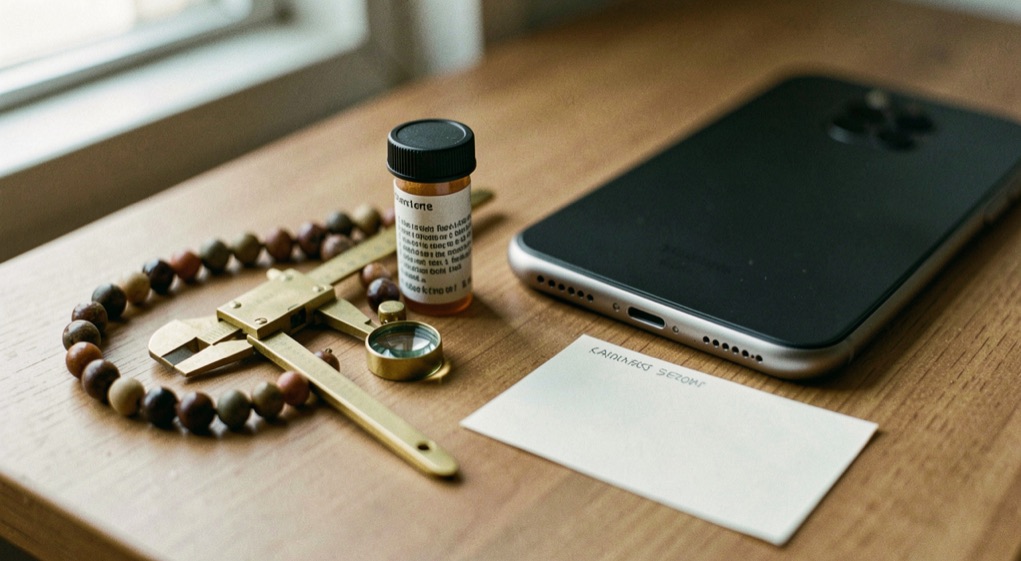
Cost one finished bead piece by adding what you actually consumed, not what you bought: the beads and findings that left the tray, the thread you cut and threw away, and the hours at the bench valued at a rate you would accept. Then compare that number against the odds of a second lot matching the first before you commit to a repeat.
How do you cost one finished bead piece?
Start with the piece in front of you, not the shopping list. Weigh or count what is no longer in the tube. If you bought a 10 gram tube of size 11 seed beads and 4 grams remain, the piece consumed 6 grams, and that is the material line. Do the same for every component: clasp, jump rings, crimps, cord, wire, cabochon, backing. Add the thread you used, plus the thread you cut off and discarded, because both came off the spool for this piece.
Price each line at what you paid per unit, not at what you hope to sell it for. A tube that cost 4.50 for 10 grams puts the 6 grams at 2.70. If you cannot remember the price, use the current replacement price and note the date you checked it, because bead prices move and a costing without a date is a guess wearing a number.
Then add time. Track it once, honestly, with a timer or a note of start and stop. Most makers underestimate finishing: the clasp, the tidy ends, the second look under daylight. If you would pay yourself 12 an hour, a three hour piece carries 36 in labour. That figure is not a wage you are owed; it is a decision aid. It tells you what the piece has to return to be worth repeating.
Add a bench overhead only if you want a full picture: a few cents per piece for needles, beeswax, lamp hours, storage bags. Keep it small and consistent, or leave it out and say so. A costing that hides its assumptions is harder to trust than one that names them.
For a worked example: 6 grams of seed beads at 2.70, one clasp at 0.80, two crimps at 0.10, 1.5 metres of thread at 0.30, three hours at 12 an hour. Materials and thread come to 3.90; labour comes to 36. The piece costs 39.90 to make once. That is the number a repeat has to beat or justify.
If you sell or gift across borders, or you are simply checking how a regulated market prices risk and conditions before you commit money to anything, a Dutch online casino guide shows how one sector publishes its licence, registration and bonus terms with a check date. The habit transfers: state the source, state the date, state the conditions.
Which losses belong in the count?
Losses are anything that left your stock for this piece and did not end up in the finished object. That includes:
- Beads culled for size, shape or colour faults, even if they go into a jar for later.
- Thread trimmed at the start and end of a pass.
- Thread that frayed, knotted or had to be cut back mid-row.
- Broken needles, split crimps, failed clasps.
- Test swatches and samples made to check a colour or a tension.
- The bead you dropped and never found.
What does not belong: the whole tube if you only used part of it, the tools you will use again, and the beads you returned to stock in usable condition. A jar of culls is not free, but it is also not consumed by this piece. Count the culls at their cost and note that they are held for another use, so the same beads are not counted twice later.
A practical rule: if you cannot point to where it went, it does not go in the count. If you can point to the bin, the jar or the floor, it does.
Losses are usually small per piece, often under ten percent of material cost, but they matter when you repeat a design twenty times. A design that loses 0.40 in culls and thread per piece costs 8 across twenty pieces, which is a tube of beads you did not plan to buy.
When is a repeat worth committing to?
The repeat is worth committing to when three things hold at once: the cost per piece is stable, the materials are still available in the quantity you need, and the time per piece is not creeping upward.
Stability first. Make the piece twice and cost both. If the second costing lands within about ten percent of the first, you have a repeatable design. If it swings wider, find out why before you buy stock: a different bead lot, a different thread, a clasp substitution, a section you rushed.
Availability second. Check that the exact bead, colour and finish are still in stock, and buy the quantity for the whole run in one order if you can. Dye lots and finish batches vary, and a repeat built from two orders can show a seam where the lots changed. If you cannot buy the full run at once, buy a sample first and compare it against your first piece under daylight before committing.
Time third. Time per piece usually falls on the second and third attempt, then flattens. If it keeps rising, the design is fighting you, and the honest move is to simplify it or stop.
What are the odds a second lot will not match?
Higher than most makers expect, and it depends on the bead, not on the seller. Seed beads from different production runs can differ in diameter by a fraction of a millimetre, which changes how they sit in a row. Dyed finishes, galvanised finishes and coated colours can shift in tone between batches, and some finishes wear faster than others. Natural materials, stone, shell, wood and horn, vary by their nature.
You cannot remove the risk, but you can price it. Before a run, buy one extra unit of each critical bead and compare it against your reference piece in daylight, not under a warm lamp. If it matches, proceed. If it does not, decide whether the difference is acceptable in the finished object or whether you need to change the design, the colourway or the supplier.
Put a line in the costing for this: a small allowance for a lot that does not match, and a plan for what you will do with the beads if it does not. Beads that do not match are still beads. They can go into a different colourway, a practice piece or a donation box, but they should not sit in a drawer pretending to be stock for a run you cannot complete.
A costing sheet you can keep
One page, six lines, dated:
- Materials consumed, priced per unit, with the date you checked prices.
- Losses: culls, trimmed thread, broken findings, samples.
- Time: hours, rate, and how you measured it.
- Overhead, if you count it, and what it covers.
- Total cost per piece.
- Notes: lot numbers, supplier, and any substitution you made.
Keep the sheet with the finished piece or in a folder by design name. When you come back in six months to repeat it, the sheet tells you what changed and what it cost then, and you can update the prices rather than rebuild the whole calculation.
What to do before you buy for a run
Before you commit money to twenty pieces, do four things in order. Cost the first piece fully. Make a second and cost it again. Buy one unit of each critical bead and compare it against your reference. Then decide.
If the numbers hold and the beads match, buy the run in one order and note the date. If they do not, change one variable at a time: the bead, the colourway, the clasp, the design. Changing several at once leaves you unable to say which one fixed it.
The point of costing is not to talk yourself out of a repeat. It is to know what the repeat costs before you are committed to it, so the decision is yours and not the drawer's.
Bench checklist
Before you commit
- Name the exact family or operation behind costing one finished piece.
- Keep the source and retrieval date beside any precise claim.
- Identify the dimension, finish, or junction that limits the project.
- Test the intended materials before committing to the full design.
Keep the caveat
What this page leaves visible
A familiar label can organize a question, but it cannot prove that two materials are interchangeable. Keep the publisher's caveat attached and leave unknowns visible.
Evidence pack
Sources close to the decision
- U.S. Federal Trade Commission: Jewelry GuidesWhy material type, treatment, size, quality, durability, origin, and other product representations should be truthful and clear.This is general U.S. guidance, not personalized legal advice or a substitute for the current regulation text. Checked August 24, 2026.
- MIYUKI Co., Ltd.: Seed bead count and weight referenceA source lane for comparing approximate count and weight information.Counts can vary with manufacturing lots, shapes, and finishes; this is not a universal conversion table. Checked August 24, 2026.