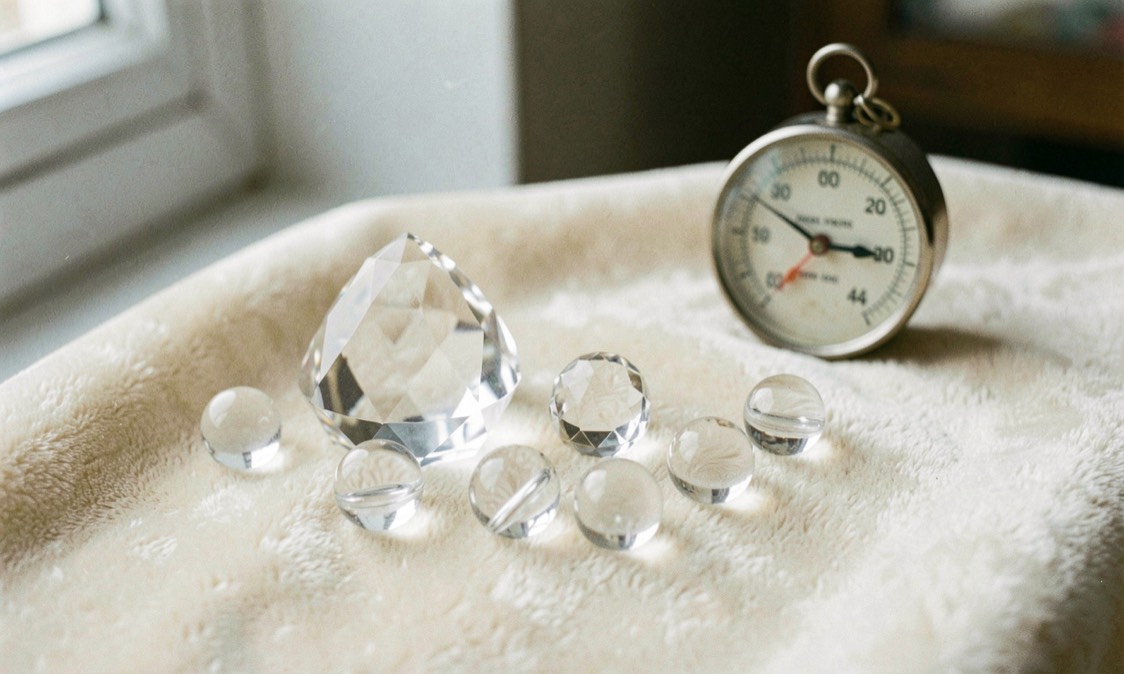
Buy one tube, not ten. Pull a few beads from each color you are considering, lay them on white paper in daylight, and look at what happens between them before any money changes hands. A palette test costs an afternoon and a handful of beads; a wrong order costs a shelf of tubes you will not use.
The same test gives you the second thing you need: a record of how long the work takes. That record is what a first commission or sale price is built from, not from a guess and not from what someone else charges.
How do you test a bead palette before buying tubes?
Work from the colors you already own. If you have nothing yet, buy the smallest pack available in the finish you intend to use, because finish changes color more than dye lot does.
String a short line, about six inches, alternating the candidate colors in the order you plan to use them. Hold it against your skin, against the fabric the piece is for, and against the background it will sit on. Photograph it in daylight, not under a lamp, and look at the photo on a different screen the next day. Colors that separate on the cord often merge in a photograph, and the photograph is what a buyer sees first.
Then do the same colors on paper. Cut a strip of white card, lay the beads in a single row, and leave a gap between each one. The gaps matter: they show you the color of the bead alone, without its neighbor lending it warmth or dulling it.
If you are building a palette for a larger piece, this is the same discipline that sits behind any visual study, whether the medium is glass or pixels. The order of construction, the way a surface catches light, the difference between a color that reads as itself and one that only reads in company: these are the questions a study answers, and they are the same questions a painter works through in digital illustration practice. Beads are not paint, but a palette is a palette, and testing it before you commit is the whole job.
What does a study on paper show that a catalog does not?
A catalog shows one bead, photographed alone, usually under studio light, usually at a size larger than life. It cannot show you three things.
First, scale. A 6/0 and an 11/0 in the same color name are different colors in the hand, because a smaller bead reflects less light and reads darker. The catalog lists both under one name. The paper shows you the difference.
Second, finish behavior. Matte, luster, metallic, and iris finishes shift depending on what is next to them and how the light hits. A metallic bead that looks rich in a tube can go flat when it sits beside a matte bead of the same hue, because the matte absorbs what the metallic throws. You only see this when the two are touching.
Third, quantity. Lay out the number of beads you think the piece needs, in the actual pattern, on the paper. Most first estimates are short by a third. Seeing the row end before the pattern does is cheaper than discovering it at row forty.
Keep the paper study. Write the date, the bead size, the finish, and the source on the back. When you reorder in a year, the card tells you what you actually bought, not what you think you bought.
How is a price built from the work a piece actually takes?
Time the piece. Not the whole piece at once, because that number is useless. Time it in stages: layout and design, stringing or stitching, finishing, and photography. Write each stage down as you go, on the same card as the palette study.
After two or three pieces of the same kind, you have a rate. Suppose a bracelet takes ninety minutes of bench time and twenty minutes of photography and listing. That is one hour and fifty minutes of work. If your bench rate is twenty dollars an hour, the labor is about thirty-seven dollars. Materials, at the bead counts you recorded, might be four dollars. Packaging and shipping supplies, two dollars. That is forty-three dollars before any profit.
Now decide the profit, and decide it as a number, not a feeling. A common approach for a first sale is to add a third to the cost, which puts the piece near fifty-eight dollars. If that number feels wrong for your market, the answer is not to shave the labor. The answer is to change the piece: fewer beads, a simpler pattern, a faster finish. Shaving labor is how a hobby turns into unpaid work.
For a commission, the same record does a second job. It lets you quote a range honestly. You can say the piece takes between six and nine hours depending on the pattern, and give a price for each end. A buyer who has never commissioned beadwork does not know what an hour of it looks like. Your stage timings are the explanation.
Write the quote down. Date it, list what is included, and note what is not: revisions, rush timing, custom colors. A quote that lives only in a message thread will be remembered differently by both of you.
What goes on the palette card?
One card per project, kept with the beads while the piece is in progress.
- Date and source of each color, with the dye lot if the tube has one.
- Bead size and finish, written out, not abbreviated.
- The paper study, taped or stapled to the card.
- Stage timings, written as you finish each stage.
- The final price and what it covered.
This card is the whole system. It replaces memory, which is unreliable about color and worse about time. After five cards you can look back and see which colors you actually reach for and which ones you bought once and never used again. That list is your next order.
When should you buy the full tube?
Buy the full tube when the color has appeared in two finished pieces and you know its neighbors. Buy the small pack when you are curious. Buy nothing when the only reason is that the color is on sale.
If a client asks for a color you do not stock, do not buy a tube to find out whether it works. Ask for a swatch, or buy the smallest quantity, and run the paper study first. The study takes an afternoon. The tube takes shelf space for years.
A note on the first sale
Price the first piece from the card, not from the market. The market will tell you whether the price holds, and that is useful information, but it cannot tell you what your hour is worth. Only your own timings can do that.
When the first piece sells, write the sale price on the card next to the cost. The gap between them is the only honest measure you have of whether the work is paying. If the gap is thin, the fix is upstream: a simpler design, a faster finish, a higher quote for the next one. The beads are not the problem, and neither is the buyer. The record is what tells you where to look.
Bench checklist
Before you commit
- Name the exact family or operation behind testing a bead palette.
- Keep the source and retrieval date beside any precise claim.
- Identify the dimension, finish, or junction that limits the project.
- Test the intended materials before committing to the full design.
Keep the caveat
What this page leaves visible
A familiar label can organize a question, but it cannot prove that two materials are interchangeable. Keep the publisher's caveat attached and leave unknowns visible.
Evidence pack
Sources close to the decision
- PRECIOSA ORNELA: DownloadsCurrent catalogs, product information cards, certificates, and resistance documents for PRECIOSA families.A certificate or test report has a stated scope and date; it must not be generalized to every color or product. Checked August 24, 2026.
- U.S. Federal Trade Commission: Jewelry GuidesWhy material type, treatment, size, quality, durability, origin, and other product representations should be truthful and clear.This is general U.S. guidance, not personalized legal advice or a substitute for the current regulation text. Checked August 24, 2026.