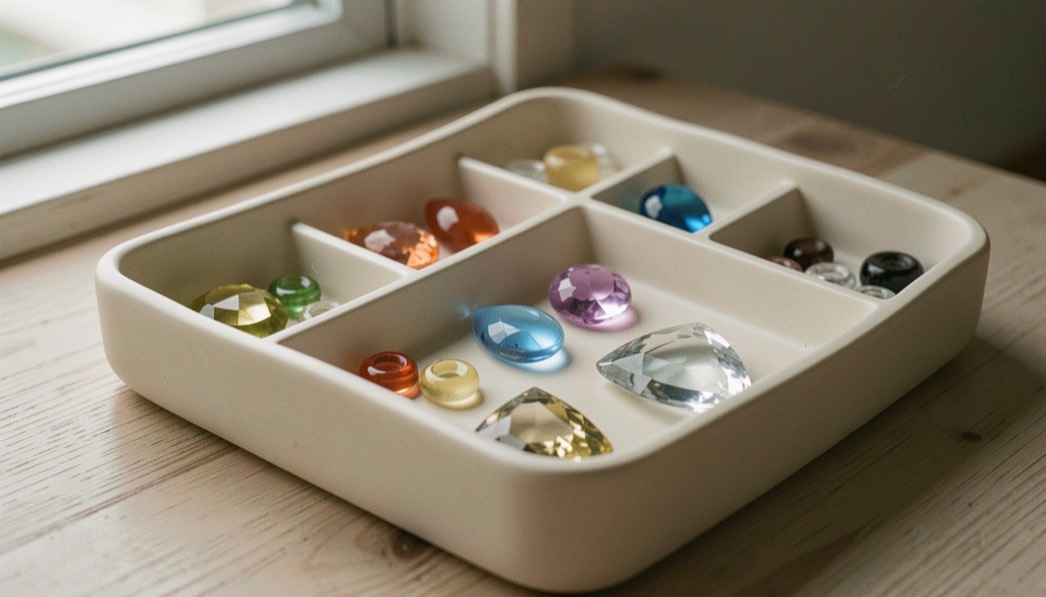
A short counted form carries one clear decision and one clear rhythm. If you can say the count out loud while your hands move, the form is doing its job. Anything longer belongs in a chart, not in a count you keep in your head.
That is the whole test. A fixed count is a container, and the container should be small enough that you never lose your place, and specific enough that the result still reads as a pattern rather than a row of identical beads. The rest of this page is about choosing that container, naming it so you can find it again, and handing it to someone who has never strung it before.
What can a short counted bead form carry?
A short counted form can carry rhythm, a color decision, a shape change, or a single repeatable unit. It cannot carry a narrative, a large color scheme, and a shape change all at once. Pick one job per count.
Think about what the count is actually doing. A count of three carries alternation: bead A, bead B, bead A. A count of four carries a pair and a pair, or a center with two shoulders. A count of six carries a small motif that closes on itself, which is why six and eight show up so often in edging and in round work. The number is not decoration. It is the smallest unit that still shows the pattern when repeated.
Poets working in short counted forms run into the same wall, and it is worth watching how they solve it. A fixed syllable count forces the writer to spend the count on one image rather than several, and the same discipline applies to beads. A Civil War haiku collection organizes short poems by ground rather than by date, which is a useful reminder that a small form can hold a place and a moment without holding a whole history. Your count of six can hold a color shift and a direction change. It cannot hold the whole necklace.
So the practical rule at the bench: write down what the count is for before you string it. If you cannot name the job in one phrase, the count is too small for the job, or the job is too big for the count.
How do you name and record a counted repeat?
Name a counted repeat by its count, its bead sequence, and its turn. Record those three things in that order, and the pattern survives without you.
A working name looks like this: 6-count, 2A-1B-2A-1B, turn at the third bead. That is enough for you to pick it up in a month and enough for another beader to follow without a diagram. The count tells the length of the unit. The sequence tells the order. The turn tells where the work changes direction, which is the part people forget and then cannot reproduce.
Keep a bench card for each counted form you use more than twice. A bench card is a single index card or a note on your phone with four lines:
- name and count
- bead sequence in letters
- turn or join point
- one line on what it is for
The last line matters more than it looks. "Edging for a flat band" and "spacer between motifs" will send you to different cards even when the counts match. Without that line you will re-invent the same count under a new name and wonder why your notes disagree.
Record the count in the same units you string in. If you string by the unit, write the unit. If you string by the inch, write the count per inch and note the bead size, because the same count in size 11 and size 8 gives you two different fabrics. Bead size is part of the name, not a footnote.
When a count fails, write down why. "Six-count, too tight at the turn with size 11" is a record. "Didn't work" is not. The failures are what keep you from repeating them, and they are the part of the card you will actually read.
How do you teach a counted form to someone new?
Teach a counted form by sound and hand before you teach it by chart. Say the count, string the count, then let the learner say it back while their hands move.
Start with the smallest version of the form that still shows the pattern. One repeat, not five. Let the learner finish the repeat, look at it, and name what changed. If they can say "the color moved" or "it turned here," they have the form. If they cannot, the count is too long for a first lesson.
Then add the second repeat and stop. The second repeat is where the learner discovers that the form is a loop and not a row, and that discovery is the lesson. Do not add a third repeat until the second one is clean.
Say the count out loud together. Counting aloud is not childish; it is how the hands learn to keep time without watching. Beaders who count silently tend to speed up at the turn, which is exactly where the form breaks.
Give the learner the bench card, not your finished piece. A finished piece shows the result. A card shows the decision. If the card is unclear to them, it is unclear, and that is useful information about your own notes.
Expect the first attempt to be loose. Tension comes later, and correcting tension before the count is stable wastes both of you. Get the count, then get the tension, in that order.
Where short counted forms break down
Short counted forms break down at the turn, at the join, and at the color change. Those are the three places where the count stops being automatic and starts being a decision.
At the turn, the count often needs one extra bead or one fewer to lie flat. Note which, and note the bead size, because the fix is size-dependent. At the join, the first and last units of a round meet, and the meeting point rarely matches the count. Decide in advance whether you will hide the join under a bead, split it, or let it show as a seam. All three are legitimate; only the undecided one looks like a mistake.
At the color change, the count and the color scheme fight. A six-count with a two-bead color block will drift around the round unless the block divides evenly into the count. If it does not divide, either change the count or accept the drift as part of the design. Write down which you chose.
Keeping a small form useful over time
A short counted form stays useful when you keep it small, name it precisely, and revisit the card before you string. The temptation is always to add one more bead, one more color, one more turn, until the count is no longer a count but a chart you have memorized by accident.
Resist that. The value of a fixed count is that it fits in your head and in your hands at the same time. When it stops fitting, it has become something else, and it deserves a new name and a new card.
Review your cards once a season. Retire the ones you never reach for. Keep the ones that still solve a problem, even if the problem is small. A count of four that reliably spaces your motifs is worth more at the bench than a clever twelve-count you have to look up every time.
Bench checklist
Before you commit
- Name the exact family or operation behind short counted bead forms.
- Keep the source and retrieval date beside any precise claim.
- Identify the dimension, finish, or junction that limits the project.
- Test the intended materials before committing to the full design.
Keep the caveat
What this page leaves visible
A familiar label can organize a question, but it cannot prove that two materials are interchangeable. Keep the publisher's caveat attached and leave unknowns visible.
Evidence pack
Sources close to the decision
- TOHO BEADS: Glass BeadsTOHO shape names, hole-profile descriptions, and the stated distinction between round, cylinder, cut, bugle, and specialty forms.The descriptions are manufacturer information; a design still needs a short fit test before substitution. Checked August 24, 2026.
- MIYUKI Co., Ltd.: Size and Shape of Seed BeadsMIYUKI seed bead family names and approximate millimeter values.The publisher describes the millimeter figures as approximate and keeps the product families separate. Checked August 24, 2026.