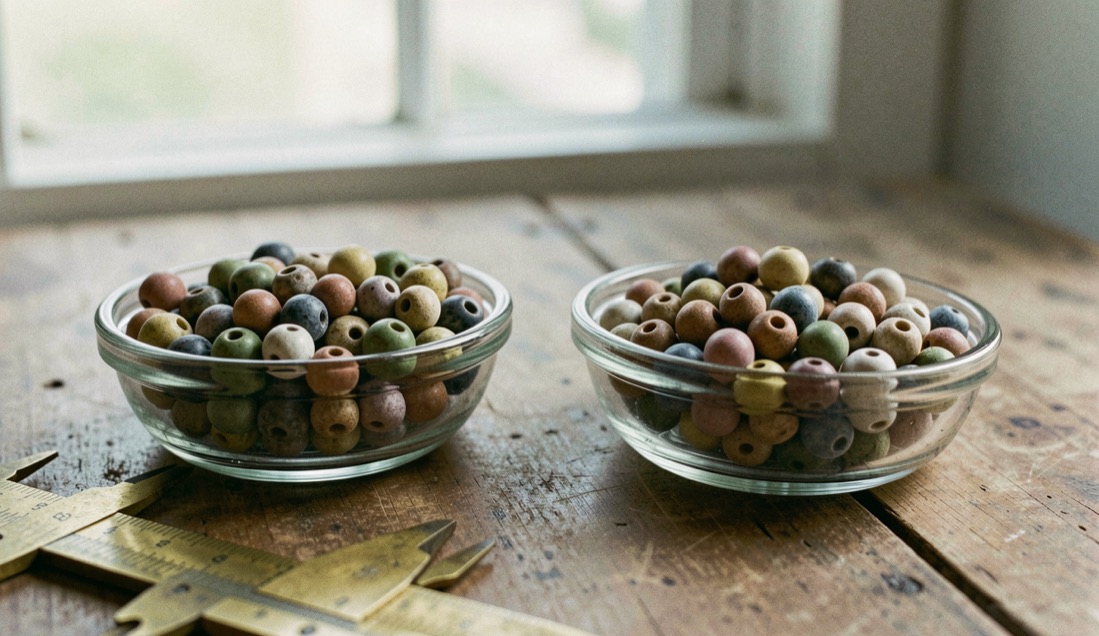
Weighing beads is the only reliable way to count them without counting. A batch of seed beads varies in size from one scoop to the next, so a strand measured by eye drifts by a few beads per repeat. If you know the average weight of one bead, you can divide the total weight of your scoop by that number and get a count you can trust to within a bead or two.
That number is the whole method. Everything below is about finding it, keeping it, and knowing when it has changed. The same logic applies outside the bead room: anyone who has spent time brewing coffee at home knows that a batch of beans is read by its roast date and origin, not by the label on the bag, and that a stored lot drifts enough to need a fresh test. Beads behave the same way.
How do you count beads by weight instead of by eye?
Start with a scale that reads to 0.01 g. A kitchen scale at 1 g resolution is too coarse for seed beads; a jeweler's scale or a reloading scale is the right tool. Calibrate it with the test weight that came in the box, or with a known coin if the manual gives a weight.
Weigh a counted sample. Count 100 beads of the size you are using, by hand, onto the scale pan. Write down the weight. Do this three times with three separate groups of 100, and average the three weights. If the three readings fall within 0.02 g of each other, the average is your working number. If they spread wider, your beads are mixed sizes and you need to sort them or accept a looser count.
The average weight of one bead is that number divided by 100. For a size 11 seed bead, a common figure is around 0.018 g per bead, but do not trust a figure from a chart. Weigh your own beads. The same size from two manufacturers can differ by 20 percent, and a matte finish weighs differently from a galvanized one.
From there, counting is arithmetic. If one bead weighs 0.018 g and you need 240 beads, you need 4.32 g. Weigh that out, and you have your count. Check it once by counting a short run of 20 beads from the pile and weighing them; if the weight matches 20 times your unit figure, the scoop is good.
Two habits keep the method honest. First, keep the scale on a level surface away from drafts, and let it settle before you read. Second, weigh the empty tray or cup first and subtract it, or use the tare button. A forgotten tare is the most common source of a wrong count.
How do you repeat a strand that came out well?
A strand that came out well is a record, not a memory. Write down four things while the strand is still on the table: the bead size and finish, the unit weight you used, the total weight of the strand, and the thread or wire you strung it on. The thread matters because it adds weight. A meter of nylon thread can weigh more than 30 seed beads, so a strand weighed with thread still on it will not match a strand weighed without.
If you want the repeat to match exactly, weigh the beads before stringing, not after. That gives you a clean number that does not depend on how much thread you used or how tight the tension was.
Keep the record with the leftover beads. A small paper tag in the bag, or a line in a notebook keyed to the bag, is enough. When you come back a year later, the tag tells you the unit weight, and the unit weight tells you how many beads to weigh out. Without it, you are counting by eye again.
For a strand you make often, make a reference card. Weigh out the exact quantity once, string it, and note the finished length. Next time, weigh the same quantity and you get the same length, provided the beads come from the same batch. If the batch changes, the unit weight changes, and the card needs a new line.
One caveat: beads sold by weight are sold by the gram, not by the bead. A 10 g tube of size 11 seed beads may hold 500 beads or 560, depending on the manufacturer and the finish. Treat the tube weight as a starting point and your own unit weight as the authority.
When does a stored batch change enough to test again?
Beads are not inert. Glass is stable, but coatings are not. Galvanized and dyed finishes can fade, flake, or darken with light and humidity. Seed beads stored in a clear bag on a sunny shelf will look different in a year. The bead itself may weigh the same while the coating has thinned, which changes the unit weight slightly and changes the color more than the count.
Test again when any of these happen: the bag has been open and resealed many times, the beads have been stored in sunlight or near a heat source, the finish looks duller than you remember, or more than a year has passed since your last unit weight. Also test when you open a new bag from the same manufacturer, even if the label matches. Production runs vary.
The test is the same as the first one: count 100, weigh, average three groups. Compare the new unit weight to the old one. A difference under 2 percent is noise; keep the old number. A difference over 5 percent means the batch has changed enough to matter, and you should write a new line on the reference card.
Color is a separate test. String a short sample of ten beads from the stored batch next to ten from a fresh batch and look at them in daylight, not under a lamp. If the stored beads read warmer or duller, the strand you make from them will not match the earlier one, no matter how carefully you weigh. In that case, either use the stored batch for a project where the match does not matter, or set it aside.
What do you write on the bag?
A bag with no note is a bag you have to re-measure. Write the unit weight, the date you measured it, and the size and finish. A strip of masking tape on the bag works; a slip of paper inside works better, because tape falls off. If you keep a notebook, give each batch a short name, such as "size 11 matte black, lot A," and use that name on the reference card for any strand made from it.
The note should also record where the beads came from. Two bags of the same size and color from different suppliers are different batches, and a strand that repeats from one will not repeat from the other. Source and date are the two facts that let you rebuild a strand months later.
How do you check a repeat without restringing it?
Weigh the finished strand against the record. If the record says the beads weighed 4.32 g and the new strand's beads weigh 4.30 g, the count is within a bead or two and the length will match closely. If the new strand weighs 4.60 g, you have about 15 extra beads, and the strand will run long.
This check catches the two common errors: a wrong tare and a changed unit weight. It does not catch a change in bead size within the same weight, which is rare in a single batch but possible if you mixed two batches in one bag. If the weight matches but the strand looks wrong, the beads are probably mixed, and the fix is to sort the bag before the next strand.
Weighing is slower than counting by eye for a single short strand. It pays back on the second and third strand, when the count has to match and the eye cannot do it. Keep the scale, keep the notes, and the repeat comes out the same twice.
Bench checklist
Before you commit
- Name the exact family or operation behind counting beads by weight.
- Keep the source and retrieval date beside any precise claim.
- Identify the dimension, finish, or junction that limits the project.
- Test the intended materials before committing to the full design.
Keep the caveat
What this page leaves visible
A familiar label can organize a question, but it cannot prove that two materials are interchangeable. Keep the publisher's caveat attached and leave unknowns visible.
Evidence pack
Sources close to the decision
- National Institute of Standards and Technology (NIST): Weights and measuresMass and measurement vocabulary behind weighing a bead count instead of counting by eye.A general metrology reference; the balance used at the bench still needs its own check. Checked September 15, 2026.
- MIYUKI Co., Ltd.: Seed bead count and weight referenceA source lane for comparing approximate count and weight information.Counts can vary with manufacturing lots, shapes, and finishes; this is not a universal conversion table. Checked August 24, 2026.