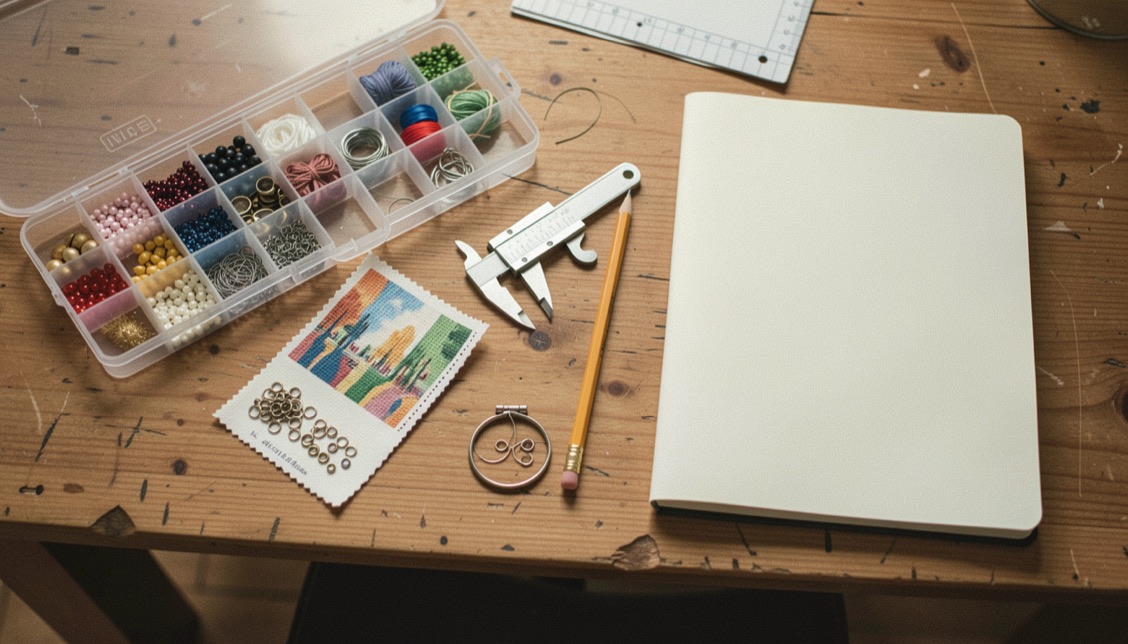
Open the container where your beads live and let the shelf decide. The next project is usually already there: a color you bought too much of, a shape you never used, a pattern you printed and set aside. Pick the one that needs the fewest new purchases, then write down why you picked it.
That last step matters more than it sounds. A choice you can explain in one line is a choice you can revisit in six months, when the beads are back in the box and the reason is gone.
How do you choose the next bead project to work on?
Start with constraints, not inspiration. Inspiration arrives after the first ten minutes of work, not before it.
- Count what you have. Pull out every bead type you own more than a handful of. Those are your real options. A project that needs 400 seed beads in a color you own 60 of is not a project yet.
- Name the technique you want to practice. Peyote, brick, right-angle weave, bead embroidery. Choosing the technique first narrows the bead choice to almost nothing.
- Match one to the other. Find the technique that your largest bead quantity supports. That is your next project.
- Check the finish. Do you want a flat piece, a tube, a rope, a shaped form? The finish decides the stitch more often than the stitch decides the finish.
If two options tie, take the one with the shorter supply list. A project that starts tonight teaches you more than a project that starts when a parcel arrives.
This is the same logic readers use when they stand in front of a full shelf and cannot decide what to read next. The Portuguese magazine Fólio Aberto covers that exact problem for books, including how to choose the next book from what is already at home, and the reasoning transfers cleanly to beads: inventory first, mood second.
One caveat. Constraint-driven choosing works when your stash is large enough to offer real options. If you own three colors and one size, the shelf is not the constraint, the shelf is the whole plan, and you should buy deliberately for a project you have already designed on paper.
How do you keep bench notes that stay useful later?
Write notes for a stranger who has your beads but not your memory. That stranger is you, eight months from now.
A bench note that survives has four parts:
- The date and the project name. Not "the blue thing." Something you would search for: "matte teal peyote cuff, second attempt."
- The exact materials. Brand, color number, size, and where you bought it. Color names change between sellers. Numbers do not.
- The decisions, not the steps. You do not need to record every stitch. Record the two or three places where you had to choose: which increase you used at the turn, why you switched needles, how many beads you added to fix the gap.
- The result, in plain words. "Cuff fits 16 cm wrist, edge curls slightly, would add one bead at each turn next time."
Keep the note with the object, not in a separate notebook you will not open. A small paper tag inside the project bag works. So does a photo of the finished piece with the note written on the back of the print.
Two habits make notes stay findable:
- One index page. A single sheet listing project name, date, and where the note lives. Update it the day you finish, not later.
- Same words every time. If you call the stitch "brick" in one note and "brick stitch" in another, your future search fails. Pick one term per thing and keep it.
What you should not do is reconstruct the note from memory a week later. Memory keeps the frustration and drops the numbers.
How do you return to a pattern you have already worked once?
Return with your old note open and the old piece in front of you. Do not start from the pattern alone.
The pattern tells you what the designer intended. Your note tells you what you actually did, which is usually different in three or four places. Those differences are the reason the second piece fits better than the first.
Work in this order:
- Read your note before you open the pattern.
- Compare the finished first piece against the pattern photo. Note where yours differs.
- Decide which differences to keep and which to correct. Write that decision down before you thread a needle.
- Start from the point where the first attempt went wrong, not from the beginning, if the pattern allows it.
If you never wrote a note the first time, you can still rebuild one. Lay the finished piece flat, count the beads across the widest row, count the rows, and measure the finished dimensions. That is enough to reconstruct the working numbers, though not the reasons behind them.
One warning about repetition. A pattern worked twice rarely produces the same object, because your tension changes and your bead batches change. If the second piece must match the first exactly, buy the beads for both at the same time from the same dye lot.
What belongs on the shelf and what belongs in the box
Not everything you own deserves to be a candidate. Sorting the shelf is part of choosing from it.
- Keep visible: beads you have used in the last year, tools you reach for weekly, the two or three patterns currently in progress.
- Store but label: partial tubes of a color you like but rarely use, specialty beads for a technique you return to occasionally.
- Let go: beads you bought for a project you abandoned and will not restart, duplicates you cannot tell apart, anything you have moved twice without opening.
The test is not whether you like the beads. It is whether you would choose them again today, knowing what you know now.
When the shelf gives you nothing
Some evenings nothing on the shelf appeals, and that is information, not failure. It usually means one of three things: you are tired of the technique you have been working, you are tired of the color family you have been working, or you have been working without finishing anything for too long.
The fix is small. Finish one thing, even a short one. A single row of bead embroidery on a scrap of felt counts. Finishing restores the appetite faster than shopping does.
If the problem is color, pull every bead you own onto a tray and sort by temperature, warm against cool. The missing color is usually obvious once everything is side by side.
If the problem is technique, pick the one stitch you avoid. Work ten minutes of it on scrap thread. Avoidance and boredom look alike from the outside and are different problems.
Keeping the record short enough to keep
A bench record fails when it is too long to write. Aim for five lines per project, no more. Date, materials, decisions, result, next time.
Five lines written on the day you finish will still be there in a year. A page written three weeks later will be half invention. The record is not for showing anyone. It is the only reliable bridge between the project you just finished and the one you are about to start, and it is the reason the shelf keeps getting easier to choose from.
Bench checklist
Before you commit
- Name the exact family or operation behind choosing the next bead project.
- Keep the source and retrieval date beside any precise claim.
- Identify the dimension, finish, or junction that limits the project.
- Test the intended materials before committing to the full design.
Keep the caveat
What this page leaves visible
A familiar label can organize a question, but it cannot prove that two materials are interchangeable. Keep the publisher's caveat attached and leave unknowns visible.
Evidence pack
Sources close to the decision
- Canadian Conservation Institute, Government of Canada: Care of Objects Decorated with Glass BeadsSupport, storage, light, dust, moisture, cleaning limits, and conservator referrals for fragile beaded objects.Museum conservation guidance is deliberately conservative and should be adapted carefully to an everyday piece. Checked August 24, 2026.
- MIYUKI Co., Ltd.: Seed bead count and weight referenceA source lane for comparing approximate count and weight information.Counts can vary with manufacturing lots, shapes, and finishes; this is not a universal conversion table. Checked August 24, 2026.